
Risk Management approach
How Jelajah Outdoor Ensures Safe and Responsible Outdoor Programs
Outdoor activities involve inherent risks.
At Jelajah Outdoor, safety is not treated as a checklist — it is built into the entire system of program design, staff training, and operational management.
Our risk management approach is inspired by best practices in Risk Management for Outdoor Programs (RMOP) developed by Viristar Consulting.
Comprehensive Site Assessments & Risk Mitigation
We conduct thorough site visits and risk assessments to tailor the safety protocols to the activity and environment.
Certified Team
Wilderness First Aid From Wilderness Medicine Associates International. Risk Management for Outdoor Programs from Viristar. Trainer Metodologi KKNI Level 4 BNSP.
Continuous Monitoring
Throughout the program, our staff monitors and adjusts to ensure the highest level of safety and enjoyment.
The Risk Management Cycle
Every program we design follows a structured process: This cycle ensures continuous improvement in safety management.
1. Risk Identification
Identifying potential hazards across the entire program.
1. Risk Analysis
Assessing likelihood and severity of each risk.
1. Risk Control
Implementing preventive and mitigation strategies.
1. Monitoring & Review
Continuous evaluation during and after programs.
We believe in upholding the highest standards of safety in every aspect of our operations, ensuring the well-being of our participants, staff, and communities.
Sandi Taruni - Director
Just Culture Approach
At Jelajah Outdoor, we recognize that safety in outdoor programs depends not only on procedures, but also on organizational culture. For this reason, we apply a Just Culture approach in our safety and risk management practices.
A Just Culture acknowledges that while individuals are responsible for their actions, most incidents occur because of system weaknesses rather than individual failure alone. Complex environments—such as outdoor programs involving dynamic weather, terrain, logistics, and human factors—require organizations to examine the entire system surrounding an incident.
Instead of focusing solely on blame, a Just Culture encourages organizations to ask deeper questions:
What conditions allowed the incident to occur?
Were procedures clear and realistic?
Did staff have adequate training and resources?
Were risks properly identified during program planning?
By examining these factors, organizations can improve their systems and reduce the likelihood of similar incidents in the future.
Key Elements of a Just Culture
Transparent Incident Reporting: Staff members are encouraged to report incidents, near-misses, and safety concerns without fear of unfair punishment. Open reporting ensures that important safety information is not hidden and allows organizations to identify patterns of risk early.
System Evaluation: Every incident or near-miss becomes an opportunity to review operational systems, including program design, supervision, communication protocols, equipment management, and decision-making processes.
Continuous Learning: Lessons learned from incidents are used to improve procedures, training programs, and risk mitigation strategies. This learning process strengthens both individual competence and organizational resilience.
Building a Strong Safety Culture
A Just Culture does not eliminate accountability. Instead, it balances accountability, learning, and system improvement. Unsafe behaviors such as negligence or intentional rule violations are addressed appropriately, while honest mistakes become opportunities for learning and improvement.
By fostering a culture of openness and reflection, organizations can move beyond reactive responses and build proactive safety systems that continuously evolve.
For outdoor education and adventure programs, this mindset is essential. It helps ensure that safety management remains adaptive, transparent, and focused on long-term improvement—ultimately creating safer and more responsible outdoor experiences for all participants.
Safety in Program Design
Risk management begins before the program starts.
Key practices include:
staff competency standards
equipment inspection protocols
participant screening
site risk assessment
emergency response planning
communication systems
Safety as Strategic Priority
For Jelajah Outdoor, safety is not only operational — it is strategic.
Safety considerations influence decisions such as:
program expansion
activity selection
staffing levels
partnerships with vendors
program scheduling
This ensures that growth never compromises safety.
Our Commitment
Our goal is to build outdoor programs that are:
Safe
Responsible
Educational
Environmentally respectful
Because meaningful outdoor experiences should always be supported by strong risk management systems.
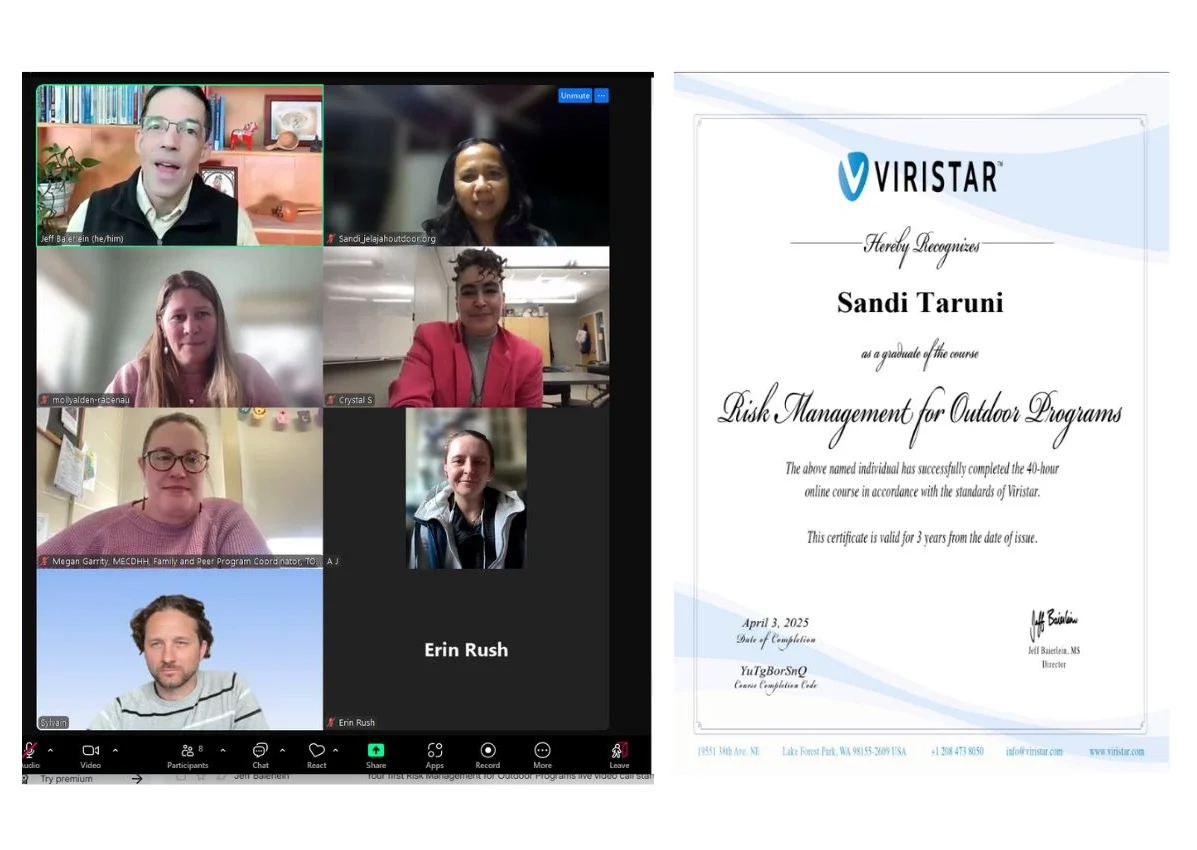
Acclaimed Risk Management Training
Risk Management for Outdoor Programs
Forty-Hour Online Training for Outdoor, Adventure, Travel, and Experiential Professionals.
Viristar’s Risk Management for Outdoor Programs course provides comprehensive training on safety management for professionals in the experiential, outdoor, wilderness, adventure and travel context.