
Outdoor Education Indonesia:
Experiential Learning Programs
for Schools
Outdoor Education Indonesia offers a powerful way to connect learning with real-world experience.
Outdoor education in Indonesia is evolving beyond traditional school trips, outings, and recreational activities. Increasingly, schools are looking for meaningful learning experiences that help students develop not only academic knowledge, but also leadership, collaboration, resilience, independence, environmental awareness, and the ability to make responsible decisions.
By taking learning beyond the classroom and into carefully designed outdoor environments, students can experience challenges, work with others, make decisions, reflect on their actions, and apply what they learn to real-life situations.
At Jelajah Outdoor, outdoor education is designed as experiential learning—where outdoor activities become a structured learning process rather than an activity for its own sake.
Our school programs combine learning outcomes, experiential learning, safety and risk management, reflection, and environmental responsibility to create meaningful experiences for students.
What Is Outdoor Education?
Outdoor education is an educational approach that uses outdoor environments and direct experience as a medium for learning and personal development.
It is more than simply taking students outside the classroom.
A well-designed outdoor education program connects:
- Clear learning objectives
- Direct experience
- Meaningful challenges
- Collaboration and decision-making
- Guided reflection
- Application to everyday life
- Safety and risk management
- Environmental and social responsibility
The outdoor environment provides situations that are difficult to replicate inside a classroom.
Students may need to navigate unfamiliar terrain, solve problems with limited resources, communicate within a team, adapt to changing conditions, manage uncertainty, or take responsibility for their decisions.
These experiences create opportunities for learning that can complement classroom education.
Outdoor Education Inonesia Is More Than a School Trip

One of the most important distinctions is the difference between a conventional school trip and an educational outdoor program.
A school trip may primarily focus on visiting a destination, enjoying activities, or creating memorable experiences.
Outdoor education starts with a different question:
What should students learn from this experience?
The destination and activities are then selected and designed around those learning outcomes.
| School Trip / Recreation | Outdoor Education |
|---|---|
| Destination-focused | Learning-outcome focused |
| Primarily recreational | Educational and developmental |
| Activity is the main objective | Activity becomes a learning medium |
| Limited reflection | Structured reflection |
| Often one-off | Can be part of a learning pathway |
| Focus on experience | Experience + reflection + application |
| Safety may be activity-specific | Safety and risk management integrated into program design |
This distinction is important for schools that want outdoor programs to contribute meaningfully to student development.
The goal is not simply to create an exciting day outside school.
The goal is to create an experience from which students can learn, reflect, grow, and apply what they have learned.
Experiential Learning: The Foundation of Outdoor Education indonesia
Experiential learning is at the heart of effective outdoor education.
Students learn by actively participating in an experience and then processing that experience through reflection and discussion.
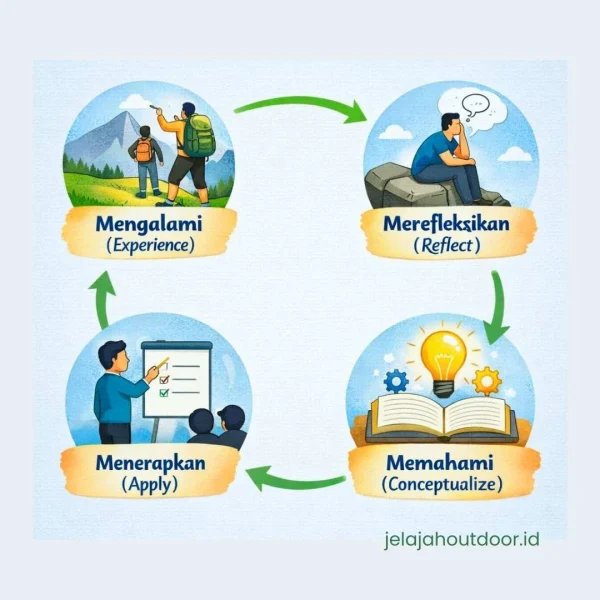
A simple experiential learning cycle can be understood through four stages:
| Stage | What Happens | Key Questions / Focus |
|---|---|---|
| 1. Experience | Students participate in an activity, challenge, exploration, expedition, or field-based learning experience. | What did we experience? What happened? |
| 2. Reflection | Students examine and discuss what happened during the experience. | What worked? What did not work? How did we respond? How did the team communicate? |
| 3. Meaning-Making | Students connect the experience to broader concepts and personal learning. | What did we learn about leadership, communication, resilience, decision-making, responsibility, or environmental stewardship? |
| 4. Application | Students consider how to apply their learning beyond the program. | How can we apply this learning in the classroom, at home, in relationships, or in future leadership situations? |
This process transforms an outdoor activity into an educational experience.
The activity is not the learning. The experience, reflection, meaning-making, and application create the learning.
For schools interested in understanding the broader approach, explore our resource on Experiential Education Indonesia.
Why Outdoor Education Matters for Students
Outdoor learning creates opportunities for students to develop capabilities that are increasingly important in education and future life.
1. Leadership and Initiative
Outdoor environments create situations where students need to make decisions and take initiative.
Leadership can emerge naturally when students are given responsibility for planning, navigation, teamwork, problem-solving, or group decisions.
Students learn that leadership is not simply about giving instructions.
It can also mean listening, supporting others, taking responsibility, managing uncertainty, and helping a team move forward.
2. Collaboration and Communication
Outdoor challenges often require students to work together.
They must communicate clearly, listen to different perspectives, divide responsibilities, manage disagreements, and coordinate actions.
These experiences can make teamwork visible.
Students can see the consequences of ineffective communication and experience the value of collaboration directly.
3. Resilience and Adaptability
Outdoor environments do not always behave exactly as expected.
Weather may change. Plans may need to be adjusted. A route may become more difficult. A team strategy may not work.
These situations create opportunities for students to practice adaptability.
Rather than immediately giving students the answer, facilitators can help them examine the situation, consider alternatives, make decisions, and learn from the outcome.
4. Independence and Responsibility
Outdoor learning can encourage students to become more responsible for themselves and others.
Depending on the program, students may manage personal equipment, prepare for changing conditions, contribute to group decisions, or take responsibility for specific team roles.
These small responsibilities can contribute to greater independence and confidence.
5. Environmental Awareness
Nature provides an authentic context for environmental learning.
Students can observe ecosystems, explore biodiversity, understand human impact, and experience the relationship between people and the natural environment.
When environmental learning is connected to direct experience, sustainability becomes something students experience rather than simply a concept they read about.
Outdoor Education for Schools in Indonesia
For schools in Indonesia, outdoor education can be designed for different age groups, learning objectives, and levels of challenge.
Programs can range from a one-day outdoor learning experience to multi-day experiential journeys.
Possible formats include:
- Curriculum-based outdoor learning
- Day trips and multi-day learning journeys
- Youth leadership camps
- Nature and conservation programs
- Basic outdoor skills
- Student development programs
- Character and leadership development
- Expedition-based learning
- Environmental education
The appropriate program depends on the school’s objectives, student age, curriculum, available time, location, and desired learning outcomes.
For this reason, a professional school outdoor education program should begin with needs assessment and program design, rather than simply selecting a list of activities.

Curriculum-Based Outdoor Education in Indonesia
Outdoor education can complement classroom learning by providing a real-world context for academic and interdisciplinary learning.
For example:
| Curriculum Area | Outdoor Learning Application | Student Development / Learning |
|---|---|---|
| Science & Environmental Studies | Investigate ecosystems, biodiversity, water, soil, weather, and human impact. | Develop scientific observation, environmental awareness, and understanding of natural systems. |
| Geography | Explore landscapes, terrain, mapping, navigation, and environmental change. | Develop spatial awareness, navigation skills, observation, and understanding of geographical processes. |
| Physical Education | Participate in outdoor activities that involve movement, endurance, and physical challenges. | Build physical confidence, movement skills, fitness, resilience, and awareness of personal wellbeing. |
| Social & Emotional Learning | Participate in team challenges and collaborative outdoor activities. | Practice communication, empathy, self-management, responsibility, teamwork, and collaboration. |
| Leadership Education | Take responsibility for decisions, team roles, group processes, and problem-solving. | Develop leadership, initiative, decision-making, accountability, and problem-solving skills. |
Outdoor Education Program Pathways
A strong outdoor education strategy can also develop progressively as students move through different grade levels.
For example:
| Program Pathway | Focus | Student Development |
|---|---|---|
| Foundation: Explore | Exploration & discovery | Develop curiosity, confidence, environmental awareness, teamwork, and basic outdoor competence. |
| Development: Challenge | Challenge & collaboration | Develop problem-solving, communication, collaboration, adaptability, and responsibility through more complex challenges. |
| Leadership: Lead | Leadership & responsibility | Develop leadership, decision-making, expedition planning, initiative, and peer responsibility. |
| Action: Apply | Application & impact | Connect learning to real-world issues, community projects, environmental stewardship, and personal action plans. |
This creates a more coherent learning journey rather than treating every school trip as an isolated event.
Examples of Outdoor Education Programs for Schools
Jelajah Outdoor develops customized outdoor education programs based on school needs and student development goals.
Programs designed to connect school learning objectives with meaningful outdoor experiences.
Learning can integrate environmental awareness, leadership, collaboration, and 21st-century skills.
A structured experiential program designed to develop leadership, communication, resilience, decision-making, and responsibility through outdoor challenges.
Students explore nature and environmental issues through observation, field-based activities, conservation projects, and reflection.
Students learn foundational outdoor competencies while developing risk awareness, teamwork, decision-making, and environmental responsibility.
Outdoor learning experiences can be delivered as one-day programs or developed into multi-day learning journeys depending on the school’s objectives and schedule.
Safety Is Part of the Learning Design
A meaningful outdoor education program must also be a responsible one.
Safety should not be treated as an additional component added after the activities have been selected.
It should be considered from the beginning of program design.
This includes:
- Understanding the environment and location
- Identifying potential hazards
- Assessing participant capability
- Designing appropriate activities
- Establishing supervision ratios
- Preparing emergency procedures
- Managing weather and environmental conditions
- Ensuring appropriate equipment
- Preparing communication and evacuation plans
- Briefing participants and staff
For Jelajah Outdoor, safety is one of the three core principles of program delivery, alongside quality and sustainability.
This approach helps schools balance meaningful challenge with appropriate risk management.
Outdoor Education Indonesia: From Outdoor Activity to Meaningful Learning
A successful outdoor education program does not end when the activity is completed.
Reflection is an essential part of the learning process.
After an activity, students may be guided to consider:
What happened?
What did we experience?
Why did it happen?
What influenced our decisions and behaviour?
What did we learn?
What does this experience tell us about ourselves and others?
How can we apply it?
How can we use this learning in school and everyday life?
This process helps students move from simply remembering an activity to understanding the learning behind it.
Designing Outdoor Education With Your School
Every school has a different context.
An international school may have different learning objectives from a national school.
A Grade 7 program will require a different level of challenge from a Grade 11 leadership expedition.
For this reason, Jelajah Outdoor follows a structured design process:
Discovery → Needs Assessment → Program Design → Implementation → Reflection → Impact Evaluation
The process begins by understanding the school’s goals, student profile, curriculum context, logistical requirements, and desired outcomes.
The program is then designed around those needs.
This allows outdoor learning to become part of the school’s broader educational strategy rather than simply an annual activity.
The Future of Outdoor Education Indonesia
The future of education requires students to be more than academically capable.
They also need to be able to collaborate, communicate, adapt to change, solve problems, take responsibility, understand their environment, and make thoughtful decisions.
Outdoor education provides a powerful context for developing these capabilities because students encounter real situations that require active participation.
For schools, the opportunity is not simply to take students outside.
It is to intentionally use the outdoors as a learning environment.
The question is therefore no longer:
“Where should we take the students this year?”
A better question is:
“What do we want our students to experience, learn, and become?”
That question is the starting point for meaningful outdoor education.
FAQ - What Makes a High-Quality Outdoor Education Program?
1. What is outdoor education and how is it different from a school trip?
Outdoor education uses the outdoors as a learning environment, not simply as a destination for recreation. Programs are designed around specific learning outcomes and combine experience, challenge, reflection, and application. A school trip may focus primarily on visiting a destination, while outdoor education intentionally connects activities to student learning and development.
2. How should experiential learning be incorporated into an outdoor program?
Activities should be intentionally connected to learning. Students should have opportunities to experience, reflect, make meaning from the experience, and apply their learning rather than simply participate in activities.
12. How can schools measure whether an outdoor education program was successful?
Success should be measured against the learning outcomes established before the program. Schools can use student reflection, teacher observations, facilitator observations, team performance, feedback, pre- and post-program reflection, and other evidence of learning to evaluate student development.
3. How do I know if the level of challenge is appropriate for students?
The challenge should match the students’ age, experience, physical capability, and developmental stage. A good program provides meaningful challenge without creating unnecessary or inappropriate risk.
2. What are the benefits of outdoor education for students?
Outdoor education can help students develop leadership, communication, collaboration, resilience, problem-solving, independence, decision-making, and environmental awareness. It also provides opportunities for students to apply classroom knowledge in real-world situations.
5. How important is safety and risk management in outdoor education?
Safety and risk management should be integrated into the entire program design. A professional provider should have a systematic approach to hazard identification, risk assessment, risk controls, emergency preparedness, supervision, and incident management.
6. Can outdoor education be connected to the school curriculum?
Yes. Outdoor education can support interdisciplinary learning in areas such as science, environmental studies, geography, physical education, social-emotional learning, and leadership education. The program can be designed around the school’s curriculum objectives and student development priorities.
7. What types of outdoor education programs can schools choose from?
School programs can include curriculum-based outdoor learning, youth leadership camps, nature and conservation programs, outdoor skills, team development, day trips, multi-day learning journeys, and expedition-based programs. The format should be selected based on student age, learning objectives, location, and available time.
8. What age groups are suitable for outdoor education?
Outdoor education can be designed for primary, middle, and senior school students. The activities, level of challenge, facilitation approach, and learning objectives should be adapted to the students’ developmental stage, experience, and capabilities.
9. How is a high-quality outdoor education program different from a recreational school outing?
The key difference is intentionality. A recreational outing primarily focuses on enjoyment and activities, while outdoor education connects activities with learning outcomes, experiential learning, reflection, student development, safety, and application.
10. What should schools consider when choosing an outdoor education provider?
Schools should evaluate more than the number of activities offered. Look for a provider that can demonstrate clear learning outcomes, experiential learning design, appropriate challenge, professional facilitation, robust safety and risk management, curriculum alignment, reflection and evaluation, and sustainability practices.
11. What role do facilitators play in outdoor education?
Facilitators do more than supervise activities. They create conditions for students to participate, make decisions, collaborate, reflect, and learn from experience. Skilled facilitators also manage group dynamics, adjust the level of challenge, and maintain appropriate safety standards.
13. How can outdoor education support sustainability and environmental responsibility?
Students can learn sustainability through direct interaction with natural environments. Programs may include conservation activities, environmental observation, responsible travel practices, waste reduction, biodiversity exploration, and reflection on human impact.
14. Can an outdoor education program be customized for our school's learning goals?
Yes. A strong school program should be designed around the school’s student profile, curriculum, learning objectives, age group, duration, location, and desired outcomes. Customization allows the outdoor experience to become part of the school’s broader learning pathway rather than a one-off activity.

Ready to Design Your School's Next Outdoor Learning Experience?
Whether you’re planning a curriculum-based outdoor learning program, youth leadership camp, nature & conservation experience, or multi-day school journey, Jelajah Outdoor can help you design a program around your students’ learning and development goals.
Tell us about your school, students, learning objectives, and preferred program dates.