
Indonesia is a living classroom, offering forests, mountains, farms, coastlines, islands, and communities where students can learn through real-world experience. EOTC programs in Indonesia (Education Outside the Classroom) provide opportunities to connect curriculum with hands-on exploration, environmental conservation, sustainability, cultural learning, and community engagement—turning places beyond the classroom into meaningful learning environments.
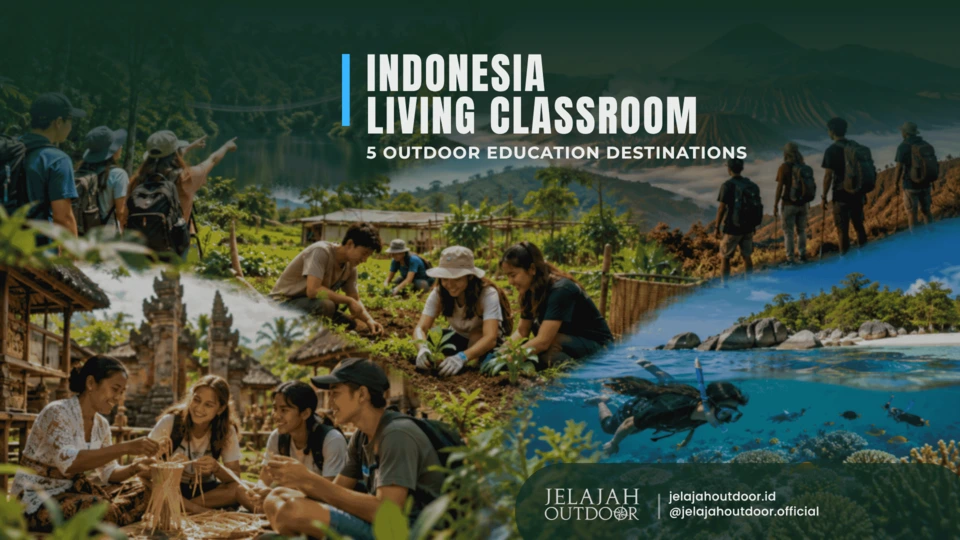
Indonesia is one of the world’s most diverse natural and cultural learning environments. Forests, mountains, volcanic landscapes, coastlines, islands, agricultural communities, and historic villages can all become classrooms where students learn through direct experience.
For schools, this creates an opportunity to develop EOTC programs in Indonesia, Education Outside the Classroom programs that connect curriculum, place, practical experience, and student development.
EOTC is more than taking students outside the school building.
It is about using an outdoor or real-world environment intentionally to support learning. Students might investigate an ecosystem, work on a farm, navigate a historic landscape, conduct field research, participate in conservation, learn traditional skills, or collaborate with a community.
The environment provides the context. The curriculum provides the purpose. And the experience provides an opportunity for students to learn by doing.
For teachers and school staff, the key question is therefore not simply:
Where should we take our students?
It is:
What can students learn from this place that they cannot learn as effectively inside the classroom?
This article explores five curated environments for EOTC programs in Indonesia, with particular attention to four areas of learning:
- Environmental & Marine Conservation
- Regenerative Agriculture & Sustainability
- Cultural & Historical Immersion
- Community Development & Service
These environments can be adapted for different age groups, curricula, learning objectives, budgets, and levels of outdoor experience.
What Is EOTC?
Education Outside the Classroom (EOTC) uses environments beyond the conventional classroom to support teaching and learning.
The setting may be a forest, farm, coastline, museum, village, historical site, community, conservation area, or other real-world environment.
EOTC is most meaningful when the outdoor experience is connected to intentional pedagogy rather than simply being an excursion. Research describing EOTC highlights action-centred, collaborative, inquiry-based, and thematic learning in authentic environments.
A useful EOTC learning cycle is:
Question → Explore → Experience → Investigate → Collaborate → Reflect → Apply
For example, instead of simply taking students to a beach, teachers might ask:
How does tourism affect a coastal ecosystem?
Students can then observe the environment, collect information, speak with local stakeholders, investigate waste or biodiversity, develop possible solutions, and reflect on their findings.
The beach has become more than a destination.
It has become a classroom.
[Guidelines for education outside the classroom]
Why EOTC (Education Outside the Classroom) Matters for Students
EOTC can support learning in ways that complement classroom-based teaching.
Experiential learning
Students encounter real situations and apply knowledge through direct experience.
Inquiry and critical thinking
Real environments present questions that do not always have simple answers.
Collaboration
Students have to communicate, divide responsibilities, solve problems, and make decisions together.
Environmental awareness
Students experience ecosystems directly rather than learning about them only through textbooks or screens.
Cultural understanding
Students can encounter local histories, traditions, livelihoods, and perspectives in context.
Student agency
Well-designed EOTC programs can give students meaningful responsibility for research, planning, action, and reflection.
Personal and social development
Outdoor and community-based experiences can provide opportunities to develop confidence, resilience, responsibility, empathy, and leadership.
For IB schools, this can also connect naturally with experiential learning and CAS. CAS requires students to participate in meaningful experiences involving creativity, activity and service, with reflection and learning outcomes.
However, an EOTC experience should not automatically be described as a CAS activity. The school and CAS coordinator need to determine whether a specific experience meets the school’s CAS requirements.
How to Choose an EOTC Programs in Indonesia Location
A good EOTC destination should be selected based on learning potential, not simply attractiveness or popularity.
Teachers and school staff can consider six questions.
1. What is the learning objective?
Start with the curriculum or learning question.
2. What environment makes that learning authentic?
Choose a place where students can encounter the subject directly.
3. What can students actually do?
Prioritize observation, investigation, participation, creation, problem-solving, and interaction rather than passive sightseeing.
4. Who can students learn from?
Local farmers, conservationists, craftspeople, community leaders, guides, researchers, and other practitioners can become valuable learning partners.
5. How will students reflect?
Build reflection into the program through journals, discussions, presentations, field reports, group debriefs, or student portfolios.
6. Can the experience be delivered safely and responsibly?
Consider student readiness, environmental conditions, supervision, emergency planning, local partners, activity-specific competency, and environmental impact.
5 Curated EOTC Learning Environments in Indonesia
The following destinations represent different environments that can support different EOTC themes.
They are not ranked as “best” destinations. Their value depends on the learning objectives, student group, program design, and operational context.
1. Situgunung, Sukabumi
Environmental & Forest Conservation
Situgunung provides a forest-based environment relatively accessible to schools in West Java and Jabodetabek.
The combination of forest, trails, lake environments, and surrounding natural landscapes creates opportunities for students to investigate ecosystems and human relationships with nature.
Learning Environment
Environment: Forest, lake, trails
Best for: Environmental awareness, biodiversity, teamwork, outdoor inquiry
Possible learning: Forest ecology, biodiversity observation, navigation, environmental impact, field journaling, conservation
Suitable challenge: Introductory–Intermediate
Program format: Day / residential
Key consideration: Accessibility, weather, terrain, group management, and environmental impact
EOTC possibilities
Students might conduct a biodiversity observation, map environmental features, investigate human impact, or develop a simple conservation proposal.
Rather than simply hiking through the forest, teachers can turn the journey into an inquiry:
What makes this ecosystem healthy, and what could threaten it?
Different subjects can connect naturally:
Science: biodiversity and ecosystems
Geography: landscape and human impact
Mathematics: field measurements and data
Language: field journals and reports
Art: nature observation and visual documentation
The forest therefore becomes an interdisciplinary classroom.
Primary EOTC theme:
Environmental Education & Conservation
[Check our latest program at situgunung]
2. Pancawati, Bogor
Regenerative Agriculture & Sustainability
Pancawati and the wider Bogor area can provide opportunities for schools to connect outdoor education with agriculture, food systems, sustainability, and responsible resource use.
The emphasis should be on finding appropriate local partners and farms that can provide authentic learning experiences.
Learning Environment
Environment: Hills, farms, gardens, rural landscapes
Best for: Sustainability, food systems, teamwork, practical learning
Possible learning: Farming, composting, food systems, soil, biodiversity, farm-to-table activities, sustainable practices
Suitable challenge: Introductory–Intermediate
Program format: Day / residential
Key consideration: Partner quality, seasonal conditions, hygiene, food safety, accessibility, and supervision
EOTC possibilities
Students can explore the journey of food from soil to table.
Depending on the host farm or learning partner, activities may include:
- planting;
- composting;
- soil observation;
- harvesting;
- farm-to-table food preparation;
- seed activities;
- biodiversity observation;
- waste reduction;
- water management;
- sustainability challenges.
A simple question can become the basis for an entire learning experience:
What does it take to produce the food we eat?
Students can investigate resources, labour, biodiversity, food waste, consumption, and sustainable agriculture.
For older students, this can develop into a sustainability inquiry:
Can a food system produce enough while protecting the environment and supporting communities?
Primary EOTC theme:
Regenerative Agriculture & Sustainability
3. Bromo, East Java
Cultural & Historical Immersion
Bromo provides a powerful environment for connecting geography, culture, history, community, and environmental change.
The volcanic landscape is not simply a dramatic backdrop. It is part of the lives, traditions, livelihoods, and histories of communities living around the region.
Learning Environment
Environment: Volcanic landscape, highland communities, cultural sites
Best for: Cultural understanding, geography, history, expedition learning
Possible learning: Local history, geography, cultural traditions, livelihoods, tourism, navigation, field research
Suitable challenge: Intermediate
Program format: Residential / expedition
Key consideration: Weather, terrain, altitude, community protocols, access conditions, and responsible tourism
EOTC possibilities
Students can undertake:
- cultural walking tours;
- community interviews;
- geographic observation;
- historical research;
- navigation tasks;
- field documentation;
- traditional craft experiences;
- responsible tourism investigations.
Where appropriate local partners are available, students might also learn traditional crafts or explore local cultural practices.
The central inquiry could be:
How does place shape culture, identity, and community life?
Students can investigate how volcanic geography influences settlement, agriculture, tourism, traditions, and everyday life.
This provides opportunities for interdisciplinary learning across:
Geography • History • Social Studies • Language • Arts • Environmental Studies
Bromo can therefore become an EOTC environment for understanding the relationship between people and place.
Primary EOTC theme:
Cultural & Historical Immersion
4. Rinjani, Lombok
Community Development, Service & Expedition Learning
Rinjani and its surrounding communities can provide a context for combining expedition learning with community engagement, conservation, and service.
However, schools should distinguish between visiting a community and meaningfully engaging with a community.
Community development activities should be designed with local partners and based on genuine local needs rather than simply creating projects for students to complete.
Learning Environment
Environment: Mountain, villages, forest, agricultural and community landscapes
Best for: Leadership, service learning, resilience, community engagement
Possible learning: Community research, conservation, service learning, expedition planning, leadership, reflection
Suitable challenge: Intermediate–Advanced, depending on the program
Program format: Residential / expedition
Key consideration: Student readiness, physical demands, community partnership, environmental conditions, emergency planning, and responsible engagement
EOTC possibilities
A program could potentially combine:
Expedition → Community interaction → Service → Reflection
Students might work with appropriate local organizations or community groups on activities such as conservation, education support, environmental awareness, or other locally identified priorities.
For IB Diploma students, this can potentially contribute to CAS when appropriately designed and approved by the school.
IB describes CAS service as an unpaid and voluntary exchange that benefits the community while providing learning benefits for students. CAS projects are also expected to involve initiative, perseverance, collaboration, problem-solving, decision-making, planning, review, and reflection.
Therefore, the goal should not be:
“Students go somewhere and help people.”
A stronger model is:
Students investigate → understand → collaborate → contribute → reflect → learn.
Primary EOTC theme:
Community Development & Service Learning
5. Bangka Belitung
Environmental & Marine Conservation
Bangka Belitung offers a strong setting for EOTC programs focused on coastal and marine environments.
Its beaches, islands, coastal ecosystems, and marine environments can provide opportunities for students to investigate the relationship between biodiversity, tourism, communities, and environmental change.
Learning Environment
Environment: Coast, beaches, islands, marine environments
Best for: Marine conservation, sustainability, environmental inquiry
Possible learning: Coral reef awareness, coastal ecology, marine biodiversity, mangroves, waste, sustainable tourism, conservation
Suitable challenge: Introductory–Advanced, depending on activities
Program format: Day / residential / expedition
Key consideration: Tides, weather, water conditions, marine activity competency, supervision, emergency planning, and conservation protocols
EOTC possibilities
Depending on the location and qualified local partners, students could participate in:
- coastal surveys;
- beach cleanups;
- mangrove activities;
- marine biodiversity observation;
- coral conservation or restoration activities where appropriate;
- waste audits;
- sustainable tourism investigations;
- community interviews;
- environmental campaigns.
A particularly powerful inquiry is:
What happens between the ridge and the reef?
Students can investigate how activities on land—agriculture, development, waste, tourism, and water management—can influence coastal and marine environments.
This creates a ridge-to-reef learning journey connecting:
Land → River → Coast → Ocean
The experience can combine environmental science, geography, sustainability, community studies, and student action.
Primary EOTC theme:
Environmental & Marine Conservation
[Learn more about Coastal and Marine Program]
Designing EOTC as a Learning Journey
A successful EOTC program should not be a collection of disconnected activities.
Teachers and program providers can design a progression:
Before the program
Prepare
Students investigate the topic, establish questions, learn relevant concepts, prepare for the environment, and identify what they want to discover.
During the program
Experience & Investigate
Students interact with the environment, conduct field activities, collaborate, collect evidence, speak with people, and solve problems.
After the program
Reflect & Apply
Students analyse what they discovered, connect field experience with classroom learning, communicate findings, and consider future action.
A simple framework is:
PREPARE → EXPLORE → INVESTIGATE → ACT → REFLECT → APPLY
This helps prevent EOTC from becoming simply:
Travel → Activity → Photo → Go home
Instead, the experience becomes part of a larger learning process.
Connecting Outdoor Education with School Curricula
Outdoor education can complement different educational approaches because it creates opportunities for students to apply knowledge and skills in real environments.
For schools using international curricula such as IB and Cambridge, the connection can be particularly relevant.
The IB approach emphasizes inquiry, action, reflection, collaboration, interdisciplinary learning, and development of the whole learner. Outdoor environments can provide authentic situations in which students practise these attributes rather than simply discussing them.
A useful learning cycle for an IB-oriented program could be:
Question → Investigation → Challenge → Action → Reflection → Application
For example, students exploring a mountain environment might investigate the relationship between tourism and environmental sustainability, collect observations, work collaboratively, develop recommendations, and reflect on their experience.
For Cambridge-oriented schools, outdoor education can provide opportunities to apply subject knowledge and practise transferable skills such as research, analysis, evaluation, collaboration, communication, and reflection. Cambridge Global Perspectives is particularly relevant because it encourages students to explore global issues from different perspectives.
However, outdoor education is not limited to international curricula.
The same principles can support students in public, private, national, national-plus, community, and other school settings.
The curriculum framework may differ, but students everywhere can benefit from opportunities to:
experience → practise → reflect → apply.
[Learn about Outdoor Education Best Practices]
Safety, Sustainability and Inclusion in EOTC Programs in Indonesia
EOTC programs should be designed around more than educational value.
They should also consider student safety, environmental responsibility, community relationships, and inclusion.
Planning should consider:
- student age and readiness;
- previous outdoor experience;
- individual needs;
- weather and environmental conditions;
- activity-specific hazards;
- supervision;
- instructor competency;
- first-aid capability;
- emergency communication;
- evacuation arrangements;
- transportation;
- community protocols;
- environmental impact;
- contingency plans.
The level of risk management should correspond to the environment and activities.
A forest investigation, farm visit, community project, marine activity, and mountain expedition each require different operational controls.
Safety should therefore influence program design from the beginning—not become paperwork completed just before departure.
[Learn more about outdoor safety & risk management]
Education Outside the Classroom (EOTC) Is for Every Learner
EOTC should not be limited to international schools or students who have access to expensive outdoor experiences.
It can be adapted for students from any school, background, community, or socioeconomic context.
An EOTC experience could take place:
- in the school garden;
- in a local park;
- beside a river;
- at a nearby farm;
- in a community;
- in a forest;
- along a coastline;
- at a historical site;
- or during a multi-day expedition.
The important question is not how far students travel.
It is:
What can students learn from being there?
A local environment can provide meaningful EOTC when the learning objective, pedagogy, facilitation, and reflection are intentional.
This makes EOTC not a privilege for a particular type of school, but a pedagogical opportunity that can be adapted to different contexts and resources.
Indonesia as a Living Classroom
Indonesia provides an extraordinary range of environments for EOTC programs in Indonesia.
Forests can become laboratories for biodiversity and conservation.
Farms can become classrooms for food systems and regenerative agriculture.
Cultural landscapes can become places for history, identity, and intercultural learning.
Communities can become partners in meaningful service learning.
Coastlines and islands can become living laboratories for marine conservation and sustainability.
The destination itself, however, does not create the learning.
The program design does.
A meaningful EOTC program connects:
Curriculum → Place → Experience → Inquiry → Action → Reflection
For teachers and school staff, the most important question is therefore not:
“Where should we take our students?”
but:
“What do we want students to understand, experience, question, and contribute—and which environment can help make that learning real?”
Bring Learning Beyond the Classroom
Looking to design an EOTC program in Indonesia that connects curriculum, real-world experience, student development, and safety?
Jelajah Outdoor works with schools to design and facilitate purposeful outdoor education and experiential learning programs tailored to students’ age, learning objectives, environment, and school context.
From environmental conservation and sustainability to cultural immersion, community engagement, leadership, and outdoor adventure, we help schools turn meaningful places into meaningful learning experiences.
Let’s design an EOTC experience that makes learning real.
Plan Your EOTC Program with Jelajah Outdoor
🌐Outdoor education program for schools
📧 info@jelajahoutdoor.id
📱 0858 8210 7460