
A School Trip Planning Guide is a structured framework that helps schools design safe, curriculum-based educational trips. It includes learning objectives, risk management, logistics, student preparation, parent communication, and reflection to ensure every trip delivers meaningful learning outcomes.
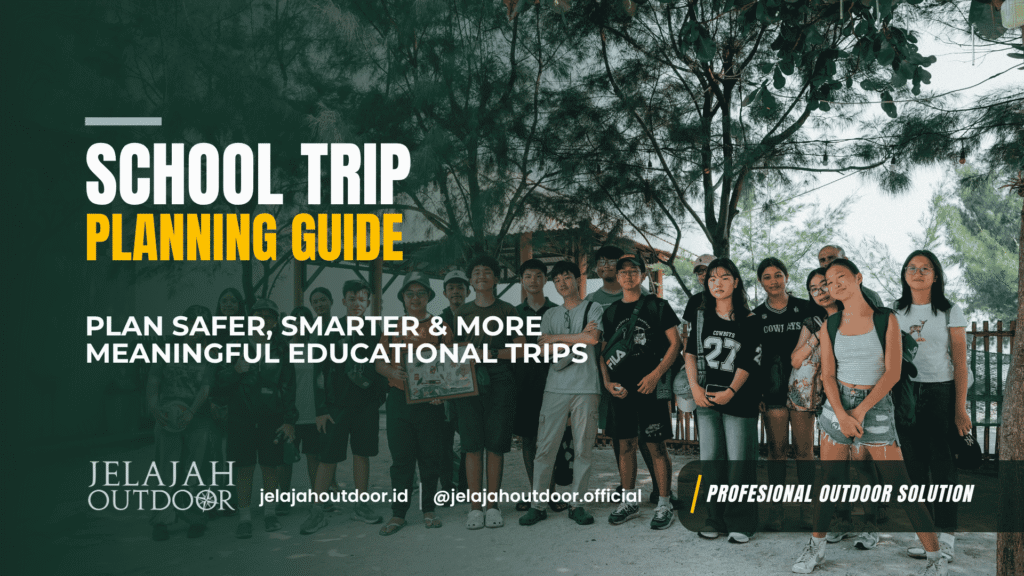
School trips have evolved far beyond a day away from the classroom. For today’s international schools and national plus schools, educational journeys are expected to support curriculum objectives, develop student character, and create meaningful learning experiences that cannot be replicated inside a classroom.
Whether you are planning a one-day environmental excursion, a student leadership camp, a cultural immersion programme, or a multi-day expedition, successful school trip planning begins with one essential question:
What do we want our students to learn?
This The School Trip Planning Guide provides practical advice for teachers, curriculum coordinators, principals, and school leadership teams looking to design safe, engaging, and curriculum-based school trips in Indonesia.
What Is a School Trip Planning Guide?
A School Trip Planning Guide is a structured framework that helps schools design educational experiences that align with learning objectives while ensuring student safety, effective logistics, and meaningful outcomes.
Rather than focusing solely on destinations or recreational activities, a well-planned guide considers:
- Educational objectives
- Curriculum alignment
- Student wellbeing
- Risk management
- Environmental responsibility
- Reflection and assessment
The result is an educational journey that supports both academic achievement and personal development.
Why Educational School Trips Matter
Experiential learning has become an essential part of modern education because students retain knowledge more effectively when they actively participate in real-world experiences.
Well-designed educational school trips allow students to:
- Apply classroom knowledge in authentic environments
- Develop leadership and collaboration skills
- Improve communication and problem-solving
- Build resilience and confidence
- Increase environmental awareness
- Strengthen cultural understanding
For schools implementing inquiry-based learning, project-based learning, or international programmes such as the IB and Cambridge curricula, outdoor experiences provide valuable opportunities to transform theory into practice.
For example, IB curriculum field trips in Jakarta often include scientific investigations, cultural heritage studies, or environmental fieldwork that encourage students to ask questions, collect evidence, and reflect on their discoveries. These experiences complement classroom learning while fostering curiosity and independent thinking.
[Found out more about Outdoor Education for Schools]
Begin With Learning Outcomes, Not the Destination
One of the biggest mistakes schools make is selecting a destination before defining the educational purpose.
Instead of asking,
“Where should we go?”
start by asking,
“What should students learn?”
This simple shift changes the entire planning process.
An effective framework looks like this:
Learning Objectives → Learning Activities → Reflection → Assessment
In this School Trip Planning Guide Examples include:
| Learning Objective | Suggested Experience |
| Biodiversity | Forest ecosystem observation |
| Geography | River and watershed exploration |
| Leadership | Student leadership camp Indonesia |
| Sustainability | Eco tourism school trip Java |
| Cultural Understanding | Cultural immersion program for schools |
| Citizenship | Service learning student trips Indonesia |
When learning objectives come first, every activity has a clear educational purpose.
Choosing the Right Destination with this School Trip Planning Guide
Indonesia offers remarkable opportunities for outdoor education, from rainforests and volcanic landscapes to marine ecosystems and cultural heritage sites.
However, selecting the right destination requires balancing educational value with operational considerations.
Schools should evaluate:
- Curriculum relevance
- Travel time
- Student age and abilities
- Accessibility
- Accommodation quality
- Weather conditions
- Environmental impact
- Availability of emergency medical services
- Learning opportunities beyond sightseeing
For schools in Jabodetabek, custom school field trips Jakarta and nearby destinations in West Java provide convenient opportunities for day programmes, while longer expeditions can include educational student tours Bali, conservation projects, or mountain expeditions across Indonesia.
Remember, the most memorable educational experience is not always the furthest destination—it is the one that best supports student learning.
[Day Trip vs. Multi-Day Trip for Schools]
Safety Is an Essential Part of Learning
In this School Trip Planning Guide, wee also notice that Outdoor learning naturally involves uncertainty. Students leave familiar classroom environments, participate in physical activities, and encounter new situations that require decision-making and teamwork.
The goal is not to eliminate all risk but to manage it responsibly.
Comprehensive field trip planning should include:
- Destination risk assessment
- Medical information review
- Emergency response procedures
- Parent communication
- Qualified facilitators
- Transportation safety
- Weather monitoring
- Communication systems
- Incident reporting procedures
- Appropriate supervision ratios
Well-managed risk creates opportunities for students to develop confidence, resilience, and responsible decision-making while protecting their wellbeing.
[Safety Management for Outdoor Programs]
A Practical School Trip Planning Checklist include on this School Trip Planning Guide
Every organising committee should review the following before departure.
Educational Planning
✓ Learning objectives defined
✓ Curriculum connections identified
✓ Reflection activities prepared
✓ Assessment methods planned
Student Preparation
✓ Parent consent collected
✓ Medical information updated
✓ Student expectations explained
✓ Packing list distributed
Logistics
✓ Transportation confirmed
✓ Accommodation inspected
✓ Meals arranged
✓ Equipment prepared
Safety
✓ Emergency contacts verified
✓ First aid equipment available
✓ Weather forecast reviewed
✓ Communication plan established
✓ Emergency procedures communicated
[ Educator’s Guide to Annual Strategic Planning for Schools – Discovery Education]
Curriculum-Based School Trips Deliver Greater Impact
The most successful curriculum-based school trips connect directly to classroom learning before, during, and after the programme.
Examples include:
Science
Students investigate biodiversity, ecosystems, and conservation through field observation.
Geography
Students explore landscapes, watersheds, climate, and human-environment interactions.
English
Students develop communication skills through reflective journals, interviews, and presentations.
Mathematics
Students collect environmental data, conduct measurements, and analyse patterns.
Arts
Students express learning through photography, sketching, storytelling, and creative projects.
Social Studies
Students examine local communities, history, culture, and sustainable development.
These experiences reinforce academic learning while encouraging critical thinking and collaboration.
Beyond Adventure: Character and Leadership Development
Outdoor programmes are about much more than physical activities.
They create opportunities for students to develop:
- Leadership
- Communication
- Empathy
- Collaboration
- Adaptability
- Responsibility
- Decision-making
A well-designed student leadership camp Indonesia encourages students to solve problems together, lead small teams, manage challenges, and reflect on their experiences in supportive learning environments.
These competencies are increasingly recognised as essential for future-ready learners.
Sustainability & Environmental Stewardship Should Be Embedded in Every School Trip
Schools play an important role in developing environmentally responsible citizens.
Outdoor education provides authentic opportunities for students to understand sustainability through experience rather than theory alone.
Students can learn to:
- Reduce waste during travel
- Respect wildlife and natural habitats
- Follow Leave No Trace principles
- Support local communities
- Understand conservation initiatives
- Appreciate Indonesia’s cultural and ecological diversity
Whether participating in an eco tourism school trip Java or marine conservation activities in Bali, sustainability becomes a lived experience rather than simply a classroom topic.
[Sustainability & Environmental Stewardship for Outdoor Activities]
[Leave No Trace Principles for Outdoor Activities]
![[Leave No Trace Principles for Outdoor Activities]](https://jelajahoutdoor.id/wp-content/uploads/2025/07/7-principles-of-leave-no-trace.jpg)
Reflection Completes the Learning Experience
Experiential learning does not end when students return to school.
Reflection transforms experiences into lasting understanding.
Teachers can encourage students to explore questions such as:
- What surprised me?
- What did I learn?
- What challenges did I overcome?
- How has this experience changed my perspective?
- How can I apply this learning in daily life?
Reflection can be completed through journals, presentations, group discussions, digital portfolios, or action projects.
Without reflection, valuable learning opportunities may be missed.
Partnering with the Right Outdoor Education Provider
Choosing experienced outdoor education providers in Indonesia is just as important as selecting the destination itself.
Schools should look for providers that demonstrate:
- Strong safety management systems
- Curriculum-aligned programme design
- Experienced facilitators
- Environmental responsibility
- Transparent communication
- Comprehensive risk management
- Flexible programme customisation
The best partners work collaboratively with schools to design programmes that align with educational goals rather than offering one-size-fits-all itineraries.
Creating Educational Journeys That Inspire
The best school trip Indonesia programmes are not remembered simply because students travelled somewhere new.
They are remembered because students discovered something new about themselves, their classmates, their communities, and the world around them.
Thoughtful school trip planning combines educational purpose, safety, experiential learning, and meaningful reflection into one cohesive experience.
For international and national plus schools, outdoor learning is no longer an optional extracurricular activity. It is an extension of the classroom—one that develops confident learners, responsible leaders, and globally minded citizens.
With careful planning and the right educational partner, every journey becomes an opportunity to inspire curiosity, strengthen character, and create learning that lasts long after students return to school.
Frequently Asked Questions (FAQ)
What is a school trip planning guide?
A school trip planning guide is a structured framework that helps schools organize safe, educational, and well-managed trips. It covers learning objectives, destination selection, risk management, logistics, parent communication, student preparation, and post-trip reflection to ensure every educational experience supports curriculum outcomes.
Why is school trip planning important?
Effective school trip planning ensures that educational goals, student safety, and logistical arrangements are carefully considered before departure. A well-planned trip reduces risks, improves learning outcomes, enhances student engagement, and provides peace of mind for teachers, parents, and school leaders.
How can educational school trips support the curriculum?
Educational school trips extend classroom learning into real-world environments where students can observe, investigate, and apply academic concepts. Curriculum-based school trips support subjects such as science, geography, history, environmental studies, language arts, and leadership while encouraging critical thinking and collaboration.
What should schools consider when choosing a destination in Indonesia?
Schools should evaluate destinations based on educational value, curriculum relevance, safety standards, travel time, accommodation quality, accessibility, environmental sustainability, and emergency support. The best destination is one that aligns with learning objectives rather than simply being a popular tourist attraction.
What are experiential learning trips in Indonesia?
Experiential learning trips in Indonesia are educational programmes that combine hands-on activities, outdoor exploration, problem-solving, and reflection. Students learn by actively participating in experiences such as ecological field studies, cultural immersion, leadership challenges, and community engagement rather than relying solely on classroom instruction.
How do IB and international schools benefit from outdoor education?
Outdoor education complements inquiry-based learning approaches used by IB, Cambridge, and other international curricula. Field experiences encourage students to develop research skills, collaboration, global citizenship, environmental responsibility, and reflective thinking while making classroom learning more meaningful.
What is the difference between a school trip and an educational expedition?
A traditional school trip often focuses on visiting a destination, while an educational expedition is intentionally designed around curriculum outcomes, leadership development, problem-solving, teamwork, and structured reflection. Educational expeditions place learning at the centre of the experience rather than sightseeing.
How can schools ensure student safety during educational trips?
Schools should conduct comprehensive risk assessments, collect updated medical information, establish emergency response procedures, communicate clearly with parents, monitor weather conditions, provide qualified supervision, and partner with experienced outdoor education providers that follow recognised safety standards.
What types of educational programmes are suitable for schools in Indonesia?
Schools can choose from a variety of curriculum-based experiences, including environmental education, student leadership camps, cultural immersion programmes, service learning projects, biodiversity studies, conservation activities, heritage exploration, and outdoor expeditions. These programmes can be tailored to different age groups and learning objectives.
Why should schools work with an outdoor education provider in Indonesia?
Experienced outdoor education providers help schools design programmes that integrate curriculum goals, student wellbeing, safety management, and experiential learning. They support schools with programme design, risk management, logistics, qualified facilitators, and meaningful reflection, allowing teachers to focus on student learning while ensuring every activity is professionally managed.
Plan Your Next Educational Journey with Jelajah Outdoor
At Jelajah Outdoor, we design curriculum-based school trips, experiential learning trips in Indonesia, leadership programmes, environmental education, and educational expeditions that combine academic learning with structured risk management.
Our programmes are built on three guiding principles—Safety, Quality, and Sustainability—to help schools deliver meaningful outdoor education experiences aligned with their learning objectives.
Whether you are looking for custom school field trips in Jakarta, a cultural immersion program for schools, service learning student trips in Indonesia, or a multi-day school expedition Indonesia, our team works alongside educators to create experiences that are engaging, purposeful, and professionally managed.
Because every great school trip begins with intentional learning—not just an itinerary.