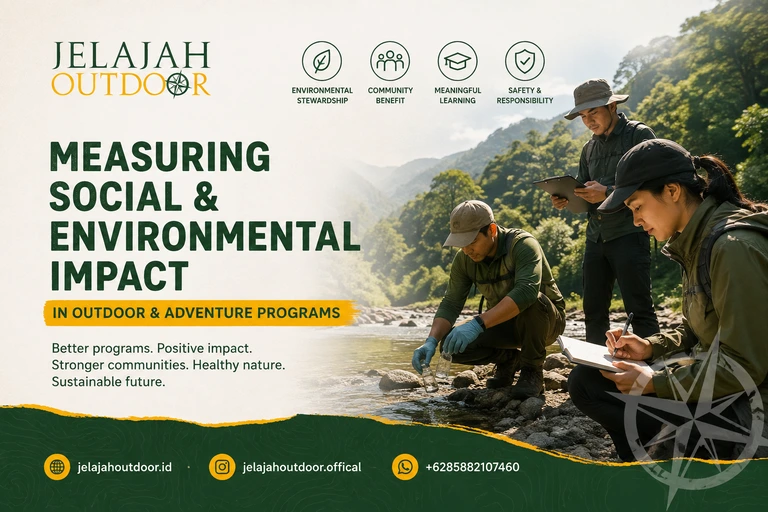
Beyond “Go Green”: How to Measure Impact in Outdoor & Adventure Programs
What is environmental impact in outdoor programs?
Environmental impact in outdoor programs refers to the positive and negative effects that outdoor activities have on natural environments, including waste, carbon emissions, water use, biodiversity, habitat disturbance, and resource consumption. Measuring these impacts helps outdoor providers, schools, and companies design more responsible and sustainable programs.
Outdoor and adventure programs are often designed to create meaningful experiences. Participants hike through forests, navigate rivers, explore caves, work together on challenging activities, or participate in conservation projects.
But an important question is often overlooked:
What impact does the program actually create?
A successful outdoor program should not only be measured by the number of participants, the activities completed, or how satisfied people were at the end of the day. It should also consider what happens to the environment, communities, participants, and destination because of the program.
This is where measuring environmental impact in outdoor programs becomes important.
For schools, companies, tourism operators, and outdoor program providers, impact measurement can help turn sustainability from a statement into a practical management system.
International frameworks support this approach. ISO 20611:2018 provides sustainability requirements and recommendations specifically for adventure tourism activities, covering environmental, social, and economic aspects. The Global Sustainable Tourism Council (GSTC) Tour Operator Standard also emphasizes sustainability planning, local community benefits, cultural heritage, and reducing negative environmental impacts.
Why Should Outdoor Programs Measure Their Impact?
Outdoor activities depend directly on natural and social environments.
A trekking program needs healthy forests and trails. A river program depends on clean waterways. A marine program depends on healthy coral reefs and coastal ecosystems. School expeditions depend on local communities, cultural sites, accommodation providers, and transportation systems.
This creates a simple principle in terms of Environmental impact in outdoor programs:
If the destination supports the experience, the experience should also contribute to protecting the destination.
Measurement of Environmental impact in outdoor programs helps organizations answer several practical questions:
Are we creating more positive than negative impacts?
What environmental resources does our program consume?
How much value remains in the local community?
Are participants actually learning or changing their behaviour?
Are conservation activities creating measurable results?
What should we improve in the next program?
The goal is not to create complicated sustainability reports. The goal is to create better programs.
Start by Separating Activities, Outputs, Outcomes, and Impact
One of the most useful practices in impact measurement is understanding the difference between an activity and its impact.
Below are some Environmental impact in outdoor programs:
Consider a mangrove restoration program.
Activity: Participants plant mangrove seedlings.
Output: 500 seedlings are planted.
Outcome: 75% of the seedlings survive after 12 months.
Impact: The restoration contributes to improved habitat and coastal ecosystem resilience.
The first number is easy to communicate, but it does not tell the whole story.
The same principle applies to outdoor education.
For example:
Activity: Students participate in a Leave No Trace workshop.
Output: 80 students complete the workshop.
Outcome: Students demonstrate improved understanding of responsible outdoor behaviour.
Longer-term outcome: Students apply those practices during subsequent trips.
This distinction helps schools and program providers move from counting activities toward measuring meaningful change.
Measure Environmental Impact in Outdoor Programs
Environmental measurement should begin with the actual footprint of the activity.
Different outdoor programs will have different environmental pressures. A mountain expedition will not have the same impact profile as a coastal conservation program or a river-based adventure.
Start by identifying the most significant impacts.
Waste
Track the amount and type of waste generated during the program.
Useful indicators include:
Total waste generated
Waste per participant
Percentage of waste diverted from landfill
Single-use plastic consumption
Food waste
Waste transported out of the destination
Instead of reporting:
“Our program collected 50 kg of waste.”
A more useful measurement in Environmental impact in outdoor programs is:
“The program generated 0.4 kg of waste per participant, with 82% diverted through reuse, recycling, or appropriate disposal.”
This allows different programs to be compared over time.
Carbon and Transportation
Transportation can be a significant part of the environmental footprint of an outdoor program.
Consider measuring:
Distance travelled
Number and type of vehicles
Fuel consumption
Estimated carbon emissions
Emissions per participant
Opportunities for shared transportation
For a corporate program, this can become particularly useful when sustainability goals or ESG reporting are part of the client’s requirements.
The objective is not immediately to achieve zero emissions. The first step is to understand where emissions come from and identify realistic opportunities to reduce them.
Water and Energy
Accommodation, camps, cooking, cleaning, and other operations can consume significant amounts of water and energy.
Possible indicators include:
Water consumption per participant
Electricity consumption
Fuel used for cooking
Use of renewable energy
Number of single-use water containers avoided
Simple measurements can already reveal opportunities for improvement.
Outdoor programs operate in places that may be environmentally sensitive.
Therefore, sustainability cannot only focus on waste and carbon.
Program providers should also consider:
Trail erosion
Vegetation damage
Wildlife disturbance
Coral or marine ecosystem damage
Water pollution
Damage to caves or geological features
Visitor pressure
Changes to sensitive habitats
GSTC guidance emphasizes monitoring tourism impacts on natural heritage and biodiversity and managing visitors according to the sensitivity and capacity of natural sites.
For outdoor operators, this means asking:
“How does our activity affect the place where we operate?”
For example, a trekking provider might monitor trail condition at the beginning and end of a season.
A marine operator might record coral-contact incidents.
A cave program might establish rules to minimize physical contact with sensitive formations.
The appropriate indicator depends on the environment.
Measure Social and Community Impact
Sustainability is not only environmental.
Outdoor tourism also creates relationships with guides, communities, accommodation providers, transport operators, food suppliers, conservation organizations, and local businesses.
Useful social and community indicators include:
Percentage of local guides employed
Percentage of local suppliers used
Local procurement spending
Number of local people trained
Community satisfaction
Community participation
Number of community initiatives supported
Participant inclusion and accessibility
Staff wellbeing and development
For example, instead of saying:
“Our program supports the local community.”
A provider could report:
“65% of program procurement was spent with locally owned accommodation, transport, food, and guiding businesses.”
This provides evidence that tourism expenditure is actually reaching the destination.
GSTC identifies local employment, community support, training, and distribution of economic benefits as important components of sustainable tourism.
Environmental impact in outdoor programs also Measure Learning and Behaviour Change
For schools and corporate experiential learning programs, another important question is:
What changed in the participants?
A participant enjoying an outdoor activity is valuable, but enjoyment alone does not demonstrate learning or impact.
Consider measuring:
Environmental knowledge
Leadership confidence
Team collaboration
Risk awareness
Problem-solving
Sense of responsibility
Connection with nature
Ability to apply learning after the program
Use a simple before-and-after approach.
For example:
Before program: Environmental responsibility score = 58/100
After program: 78/100
Then, if possible, conduct a follow-up several weeks or months later.
This helps determine whether the program created temporary awareness or a more lasting change in behaviour.
For schools, this can connect directly with learning objectives.
For companies, it can connect outdoor experiences with leadership, teamwork, employee engagement, and organizational values.
Measure Positive and Negative Impacts
A credible impact system should not only document positive achievements.
It should also identify negative impacts.
For example:
Positive impact
Local employment created
Local suppliers supported
Environmental learning delivered
Habitat restored
Waste reduced
Negative impact
Transport emissions
Waste generated
Trail erosion
Water consumption
Wildlife disturbance
This creates a more balanced picture of program performance.
The purpose is not to prove that a program has zero impact.
The purpose is to understand its impact and continuously improve it.
Use a Simple Outdoor Impact Dashboard
Outdoor program providers do not need hundreds of indicators.
A practical starting point is 10–15 indicators.
Environmental
Waste per participant
Percentage of waste diverted
Estimated carbon emissions per participant
Water consumption
Environmental incidents
Biodiversity or habitat indicators
Social
Local employment percentage
Local procurement percentage
Community satisfaction
Participant learning improvement
Behaviour-change indicators
Operational
Sustainability training hours
Sustainability incidents
Corrective actions completed
Improvement actions implemented
The indicators should be reviewed regularly and adjusted according to the type of program.
A mountain expedition, school camping program, corporate team development program, and marine conservation activity should not necessarily use exactly the same indicators.
From Measurement to Continuous Improvement
Measurement only becomes valuable when the information is used.
At the end of each program, ask:
What happened?
Why did it happen?
What does the data tell us?
What should we change?
How will we measure the improvement?
For example:
If waste per participant increased, review food packaging and procurement.
If local procurement decreased, review supplier selection.
If trail damage increased, review group size, route selection, and visitor management.
If participant learning did not improve, review the program design and reflection process.
This creates a continuous improvement cycle:
Measure → Analyze → Improve → Measure Again
Sustainability Should Be Designed Into the Program
The strongest approach is not to add sustainability at the end of an outdoor program.
It should be considered during program design.
At Jelajah Outdoor, this means looking at sustainability alongside learning objectives, safety, logistics, risk management, and participant experience.
Before the program:
Identify environmental and social risks.
Establish relevant impact indicators.
Select responsible suppliers.
Set measurable targets.
During the program:
Monitor resource use.
Observe environmental conditions.
Engage local stakeholders.
Record incidents and observations.
After the program:
Analyze the data.
Gather participant and community feedback.
Evaluate outcomes.
Document lessons learned.
Improve the next program.
This approach makes sustainability part of the operating system rather than a separate activity.
FAQ — Measuring Social & Environmental Impact in Outdoor Programs
What is environmental impact in outdoor programs?
Environmental impact in outdoor programs refers to the positive and negative effects that outdoor activities have on natural environments. These can include waste generation, carbon emissions, water consumption, trail erosion, biodiversity disturbance, habitat damage, and resource use.
Why is it important to measure environmental impact in outdoor programs?
Measuring environmental impact helps schools, companies, and outdoor program providers understand the effects of their activities and identify opportunities for improvement. It allows sustainability to become a measurable part of program planning rather than simply a statement or activity.
What environmental indicators should outdoor programs measure?
Common indicators include waste per participant, percentage of waste diverted, carbon emissions, water and energy consumption, single-use plastic use, trail or habitat damage, wildlife disturbance, and other environmental incidents relevant to the destination.
How can outdoor programs measure their social impact?
Social impact can be measured through indicators such as local employment, local procurement, community participation, community satisfaction, training opportunities, participant inclusion, and the amount of economic value retained within the local community.
How can schools measure the impact of outdoor education programs?
Schools can measure both learning and behavioural outcomes. Useful indicators include environmental knowledge, teamwork, leadership, problem-solving, risk awareness, responsibility, and changes in participant behaviour. Pre-program and post-program assessments can help demonstrate measurable learning outcomes.
How can companies measure the impact of corporate outdoor programs?
Companies can measure participant learning and organizational outcomes alongside environmental and community indicators. Examples include changes in teamwork, leadership confidence, communication, employee engagement, sustainability awareness, local economic contribution, waste generation, and carbon emissions per participant.
What is the best way to start measuring sustainability in an outdoor program?
Start with a small set of relevant indicators rather than trying to measure everything. Identify the program’s main environmental and social impacts, establish a baseline, set measurable targets, collect data during the program, and use the results to improve future programs. A simple cycle of Measure → Analyze → Improve → Measure Again is a practical starting point.
The Goal Is Better Outdoor Experiences, Not Just Better Reports
Measuring social and environmental impact should not become another administrative burden.
It should help us design better experiences.
For schools, this can mean connecting outdoor education with environmental responsibility and meaningful learning.
For companies, it can connect experiential learning with sustainability, employee engagement, and community contribution.
For outdoor and adventure providers, it can strengthen operational quality, destination stewardship, and client trust.
Most importantly, measurement creates accountability.
We should be able to answer not only:
“What did we do?”
but also:
“What changed because we did it?”
That is the real purpose of measuring environmental impact in outdoor programs.
At Jelajah Outdoor, we believe outdoor experiences should create value for people while respecting the places and communities that make those experiences possible. Through thoughtful program design, responsible operations, safety and risk management, and continuous evaluation, outdoor activities can become a meaningful tool for learning, leadership, community connection, and environmental stewardship.